
Radio Cadena Agramonte emisiora de Camagüey





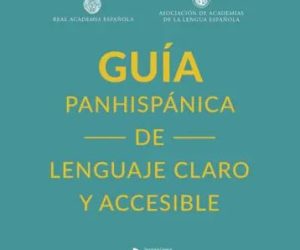
Spain, October 29.- The Royal Spanish Academy (RAE) and the academies of the Asale (Association of Academies of the Spanish Language) have published the Pan-Hispanic Guide to clear and accessible language, a work that pursues transparency, synthesis, understanding and ease of use and that seeks to explain clear language with clear language.
The Guide... (Espasa, 2024), which has the support of the Ibero-American General Secretariat, attempts to offer resources, warnings, recommendations and knowledge that provide light and clarity in the language, as advanced in the institutional presentation that it had place during the closing of the I Convention of the Pan-Hispanic Network of Clear and Accessible Language, held in the RAE in May of this year.
In addition to dealing with communicative principles, it covers different aspects of plain language and legal language. Also about the relationship of clear language with that of the Administration, the company, the world of consumption or medicine, among others.
In a statement issued this Monday, the RAE noted that the publication "extends the demand for clarity to all areas in which the misuse of language becomes a barrier of incomprehension for citizens."
In this regard, he comments that “the language of public powers can sometimes be obscure, incomprehensible. For this reason, in the face of the opacity of some provisions that affect citizens in all areas of their lives, an international movement has crystallized that, under the banner of 'clear language', demands a new right: the right to understand."
The work abounds in advice and resources aimed at achieving clear texts, guidelines supported by a brief theoretical foundation that clarifies its reasons and scope.
In the statement, the RAE clarifies that “the standard set by the dictionaries, grammars and spelling of the RAE and Asale is always followed. Both ensure the correctness and expressive capacity of Spanish. They pursue a language that is transparent in its grammatical descriptions, rich in lexical resources, secure in its spelling and endowed with the discursive guidelines of clarity forged by our great writers.”
In short, he adds, “a language that enables communicative success in all areas: from family conversation to scientific or humanistic treatises, from a request to a law or a sentence.”
The RAE emphasizes that clear language and communicative accessibility maintain close ties.
“Both concepts coincide in the same objective: solving problems in understanding messages. Accessibility has evolved towards a design designed from the beginning to serve everyone and in all circumstances (universal design).
“This guide also details various issues related to legibility or communication and spatial, visual, auditory and cognitive accessibility. It also dedicates a section to easy reading, its relationship with clear language, the concepts on which it is based and the criteria it requires.
The guide highlights the importance of good linguistic training for professionals, greater education of citizens in scientific disciplines and the mediating role of well-trained press professionals.
In grammar, among other topics of greater difficulty in everyday use, prefixes, long derivatives, gerunds, gender, passives, coordinations, subordinations appear.
In the speech section, frequent problems are addressed such as the long paragraph, the subsections, the enumerations and the features that make up the so-called legal style.
In semantics, issues such as meaning, sense, connotation, presuppositions, implicatures, ambiguity, vagueness, indeterminacy, contradictions, paradoxes, euphemisms and redundancies are included.
“Respect for spelling rules is essential for the clarity of written messages,” the RAE emphasizes in the statement.
“This guide highlights the influence that accentuation, punctuation, and the proper use of capital letters have on clarity, as well as the effect of opacity caused by undigested words that come to us from outside, what we call crude foreign words. ”, he concludes. (Text and Photo: Cubadebate)