

Radio Cadena Agramonte emisiora de Camagüey





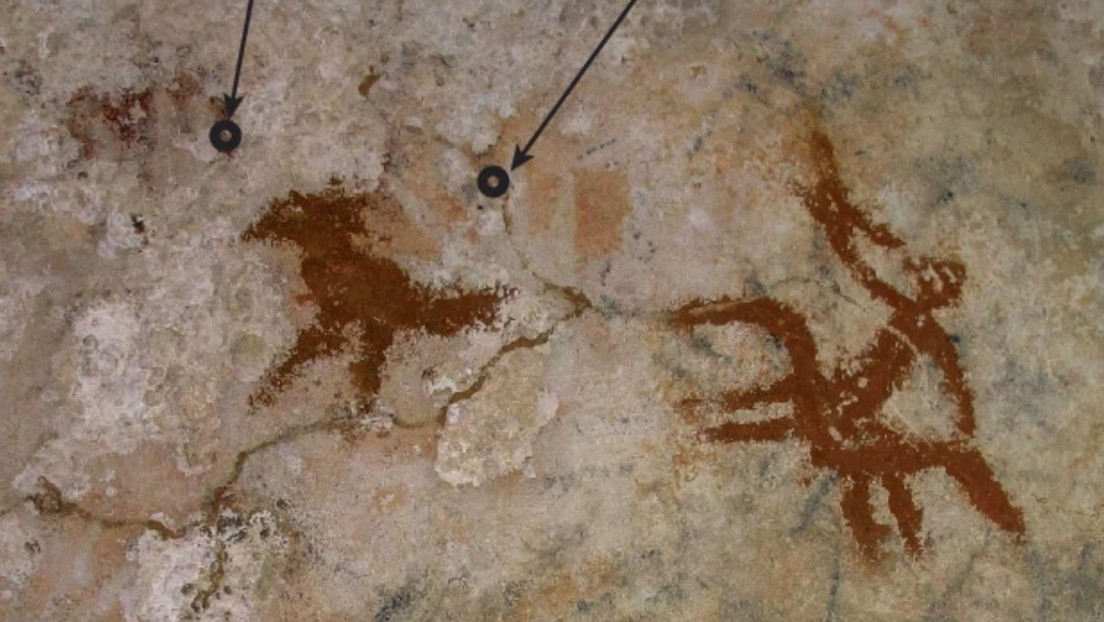
Indonesia, located in Southeast Asia and Oceania, solidifies itself as an epicenter of the origins of humanity's creative expression. An international team of scientists has identified a hand stencil on the island of Sulawesi (also known as Celebes) with an age of at least 67,800 years.
The research, published this Wednesday in the journal Nature, makes this work the oldest artistic manifestation on the planet found to date. The discovery occurred in the Liang Metanduno cave, located on Muna Island, part of the Sulawesi archipelago.
With this discovery, the hand stencil displaces in history books the three human figures interacting with a wild pig, a work from 51,200 years ago found in a cave on the island of Celebes in June 2024. The new image surpasses the previous record by more than 15,000 years.
To determine the age accurately, the researchers analyzed mineral deposits that had accumulated naturally on the rock. These layers function as a temporal seal, allowing for an unprecedented precise calculation of the minimum age of the pigment.
The work possesses an unusual characteristic: the original stencil received an intentional modification. The study's authors observed that the contours of the fingers were narrowed to give the hand the appearance of a claw. According to experts, this detail suggests a deep symbolic meaning that was maintained across generations.
Archaeological evidence indicates that the Liang Metanduno cave was not a temporary site. On the contrary, the place functioned as a space for constant artistic production for at least 35,000 years. Archaeologist and geochemist Maxime Aubert, the project leader, indicated that Sulawesi was home to one of the world's richest and most stable artistic cultures from the beginning of its human occupation.
Milestone in Migrations
Beyond its aesthetic value, this discovery is a key piece for understanding the process of populating the rest of the world. The date of 67,800 years reinforces the theory of an early human arrival in Australia, when it was still part of the Sahul continental mass, which also included Tasmania and New Guinea.
The study, a result of collaboration between Griffith University (Australia), the Indonesian National Research and Innovation Agency (BRIN), and Southern Cross University, highlights that this cave art in Sulawesi validates the importance of the "northern route" in human expansion across Southeast Asia.
Rare creature that lived before dinosaurs appears in a cave painting
"Our new research phase shows that Sulawesi was home to one of the oldest and richest artistic cultures in the world, whose origins date back to the beginning of the island's human occupation," stated archaeologist Maxime Aubert.
The data published by the journal Nature also facilitate understanding the paths of these migratory groups. The researchers analyze two main routes: one to the north, which passes through islands like Sulawesi towards New Guinea, and another to the south, involving direct sea crossings to northern Australia. The antiquity of the stencil in Liang Metanduno gives definitive weight to the northern route in this historical process. (Text and photos: RT)