
Radio Cadena Agramonte emisiora de Camagüey





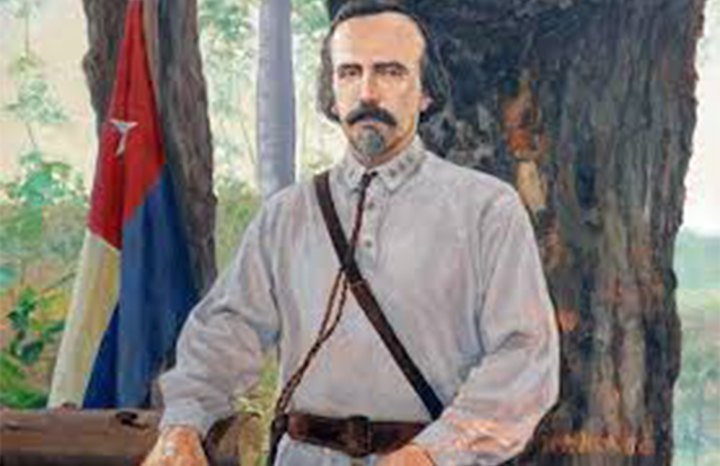
Cuba evokes and bows with respect and admiration before the last and solitary battle of Carlos Manuel de Céspedes, the Father of the Nation, on February 27, 1874, 152 years ago, a painful moment reflected by history that occurred in a remote spot in San Lorenzo, in the Sierra Maestra, where he arrived trying to evade the fierce persecution of forces in the service of the Spanish colonial regime.
He was alone that day and with very few bullets in his revolver, but even so he decided to confront and try to move away with his horse from the house where he was, to prevent it from being captured and this in turn contributing to causing demoralization among the independence fighters.
But the inevitable happened. That wounded body that fell into the ravine was that of a genuine Cuban who defended himself and fought, revolver in hand, until the last moment; he even turned and shot twice at his attackers, with extraordinary courage, disobeying those who urged him to surrender.
After recovering the corpse from the cliff, the pertinent investigations took place, and as a result of the expert and forensic report - carried out by the colonial authorities - testimony is offered that he did not surrender, he fired two shots, one at the captain and another at the sergeant who accompanied the group of five men. The shot from the Spanish sergeant was the one that brought him down.
A mature man, still relatively strong and relatively young for the era, Carlos Manuel de Céspedes was, but the rigors of the campaign and the real via crucis that betrayal had made him endure turned him into a person of senile appearance and he was almost blind, close to 55 years of age.
The Old President, as he was respectfully called by the natives of that area, with whom he formed close relationships during his stay in San Lorenzo since January 23, 1874.
Even in these times, hypotheses are discussed as to whether it was a chance event or a betrayal that discovered his last refuge.
It cannot be forgotten that Céspedes occupies a leading place in the history of Cuba, he was the initiator of the war for independence, and also the first President of the Republic in Arms, a responsibility entrusted to him upon the holding of the Assembly of Guáimaro, in April 1869.
Fully carrying out that function was not easy for him, given the antagonism of the members of the House of Representatives, who finally removed him from that position in October 1873 and even forced him to accompany the new government and the members of the House for two months.
The distinguished Dr. HortensiaPichardo and her husband José Antonio Portuondo, deeply researched the life of the Father of the Nation and in 1974 published in three volumes a notable compilation of the patriot's papers, except for the Diary which would appear later. They were convinced of his real death in combat, thus ruling out a possible suicide.
Both specialists based their work on the vast knowledge of the patriot's actions and his advanced political thinking, and analyzed the historical events of the Ten Years' War; likewise, they determined that his fate had been sealed long before the day of the tragedy of his death.
A conviction shared by the majority of historians, researchers, and righteous people of the nation, considering the precedent of October 27, 1873, when a conspiracy carried out by the House of Representatives, in the town of Bijagual, in the eastern territory of Jiguaní, removed Céspedes from his position as president of the Republic.
Carlos Manuel did not want confrontations between Cubans to occur because of his cause and he obediently abided by his removal by majority vote in the House of Representatives. He was aware that opposing it would have fostered a division among Cubans capable of destroying the Revolution.
Caudillismo, the intrigues of divisiveness, extreme regionalism, and rancor triumphed over the decorum that many patriots had, and, disguised with legality, they accused him of nepotism and dictatorial methods, thereby justifying the deposition of the worthy man who had given the cry of independence or death and raised a nation in combat for freedom.
The high treason perpetrated by the House in Bijagual was once described as a political crime. The lost Diary that friendly hands delivered many years later to Dr. Eusebio Leal and which he published in 1992, expresses the patriot's opinion regarding his main enemies, written shortly before his fall in combat.
Anyone who has studied his ideology knows that, in peacetime conditions and with colonialism and slavery eradicated forever, he advocated for the total predominance of a free and just republic, with equal rights for all.
On the 152nd anniversary of his last confrontation, it is necessary to evoke the patriot who asked Cambula Acosta to make a Cuban flag to preside over the uprising, a design painted by himself on paper. When it was finished, he told her to take it and shout to the revolutionary forces that they should die before surrendering it to the enemy.
It persists in the collective memory that Céspedes, from his sugar mill La Demajagua, started the Ten Years' War, was the first to free his slaves, marched into battle with the cry of "Long Live Free Cuba!" and, after seeing his troops reduced in an unequal challenge against the Spanish forces, stood up and replied to the defeatists: "We still have 12 men; that's enough to win the independence of Cuba!"
Fidel Castro did the same when he reunited the surviving expeditionaries of the Granma yacht at Cinco Palmas, after the baptism of fire at Alegría de Pío, in 1956.
Signs that the Cuban Revolution is one single entity and began with the feat undertaken by Carlos Manuel de Céspedes, due to the deep-rooted political and social transformation that its promoters proposed, beyond the mere just act of the island's independence. (Source: ACN)