
Radio Cadena Agramonte emisiora de Camagüey





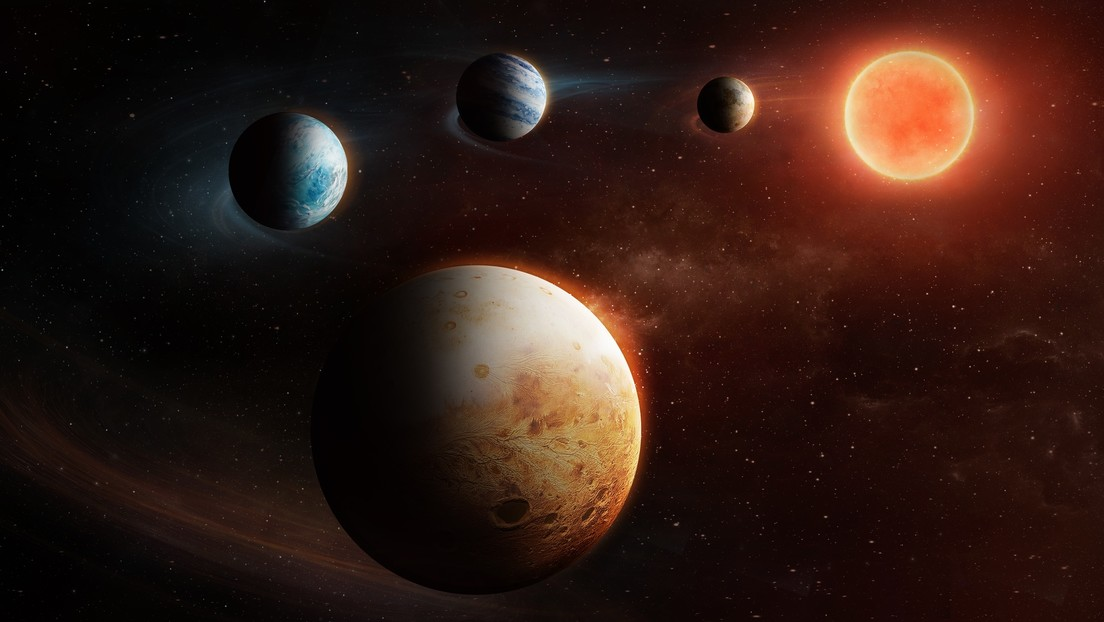
An team of astronomers has identified an unusual planetary system around the red dwarf star LHS 1903, whose observations challenge conventional models of planetary formation. Measurements made by the CHEOPS satellite of the European Space Agency (ESA) revealed an arrangement of planets that contradicts the expected typical structure, Science News reports.
According to classical theory, based on the configuration of our solar system, rocky planets are always located in the orbits closest to the star, while gas giants are situated in the outer regions. This is the case with Mercury, Venus, Earth, and Mars — rocky and close to the Sun — followed by Jupiter, Saturn, Uranus, and Neptune — gaseous and farther away.
However, the planetary system orbiting LHS 1903, a faint red dwarf located about 116 light-years from Earth in the Milky Way, presents a different order.
Initially, scientists detected three planets around the star: the first was rocky and the next two were gaseous. This distribution coincided with what was predicted, since powerful stellar radiation usually expels light gases from close orbits, leaving only solid cores. However, the discovery of a fourth planet, also rocky and located beyond the gas giants, caused surprise among researchers. It is the first time a sandwich-like structure (rock, gas, gas, rock) has been observed in space.
To explain this configuration, researchers published a new model on the evolution of planetary systems in the journal Science. According to this theory, the planets around LHS 1903 did not form simultaneously.
The fourth rocky planet likely formed much later than the others, at a time when the system's gas disk had already almost completely dissipated. In this way, the new planet had no opportunity to accumulate a gaseous envelope, despite being far from its star.
This discovery demonstrates that the solar system is not a universal model for the entire Universe. The diversity of scenarios in the formation of worlds is much greater than previously believed. (Text and photo: RT)