
Radio Cadena Agramonte emisiora de Camagüey





By Jorge Wejebe Cobo/ ACN Special Service
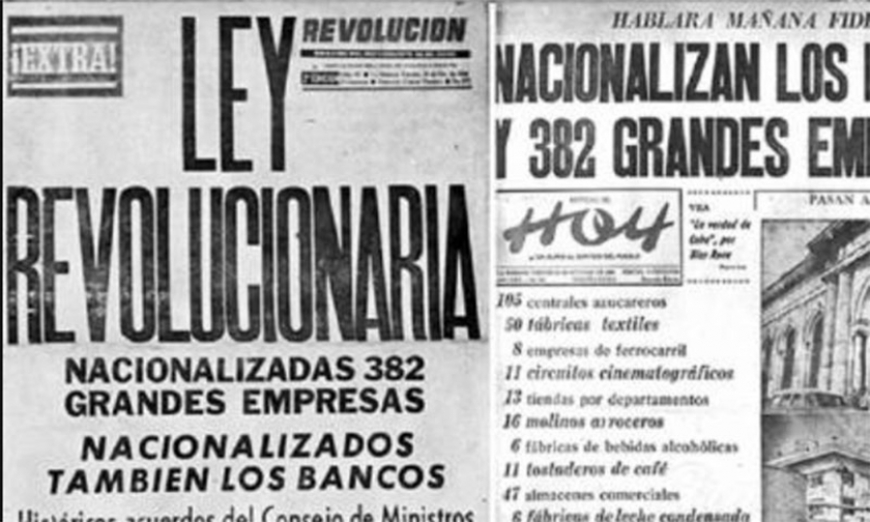
On October 24, 1960, Fidel Castro, in his capacity as Prime Minister, signed Law 851 for the Defense of the National Economy, Resolution No. 3, for the nationalization of 166 American companies and firms, in response to the first actions of the economic, commercial and financial blockade of the US against Cuba, which included the reduction of the sugar quota.
(…) “We will take away center by center! And we will take away, penny by penny, every last American investment in Cuba! ”exclaimed the revolutionary leader.
In this way, the Ten Cents and Sears stores, the Burrus Flour Mill, Mcfarlane Foundry, Firestone, Goodrich, CanadaDry, Coca Cola, Minimax, Ekloh, Abbot, Squibb, Hershey Railway and others were expropriated.
Since then, the US government presents that first action by Havana as a decision that unilaterally and without reason broke the relations between both countries, and the White House does not recognize these seizures, nor the following ones, as legitimate, which is why they refuse to negotiate the issue and the compensation proposed by the Island, in accordance with international law.
While they were spreading these lies, their secret plans far surpassed their first economic actions. It is worth remembering that much earlier; President Dwight Eisenhower approved, on March 16, 1960, the Program of Covert Action against the Castro Regime that included intelligence operations, economic blockade, terrorist plans, subversion, propaganda and finally direct aggression.
They were the largest and most complete covert operations that the United States organized against another country in peacetime, and they reflected the desperation and frustration of the political class of the northern neighbor who could not resign themselves to losing their control over the island, destined to become in a gambling den run by the American mafia, with the complicity of the dictatorship of Fulgencio Batista.
But the promoters of that initial program against Cuba could not be described as formal, since before its approval in practice they carried out sabotage in the cities, burning of sugarcane fields, uprisings and terrorist attacks such as the one that occurred on March 4 with the bombing of the steamship La Coubre that brought weapons and ammunition acquired in Belgium, which was interpreted by the Cuban leadership as a prelude to the attacks.
It can be stated that the most exact definition of this criminal policy against the Largest of the Antilles, and which remains unchanged to the present, had already been stated in the declassified memorandum in the 1990s of the Undersecretary of State, Lester D. Mallory, of the 6 April 1960 in which he explained:
“The majority of Cubans support Castro… the only foreseeable way to reduce his internal support is through disenchantment and dissatisfaction arising from economic malaise and material difficulties… all possible means must be quickly used to weaken the economic life of Cuba …a line of action that, being as skillful and discreet as possible, achieves the greatest advances in depriving Cuba of money and supplies, to reduce its financial resources and real wages, provoke hunger, despair and the overthrow of the Government.”
63 years have passed since the issuance of Law 851 for the Defense of the National Economy, with which the Largest of the Antilles faced the first aggressive actions of the powerful neighbor and since then the empire's strategy has not changed and it continues to bet on going bankrupt with blocking the unity of our society and promoting subversive processes, now supported by new communication technologies and social networks, in an effort doomed to failure in the face of the decision of the Cuban people who have known how to defend and maintain the conquests of the Revolution. (Photo: Archive)