
Radio Cadena Agramonte emisiora de Camagüey





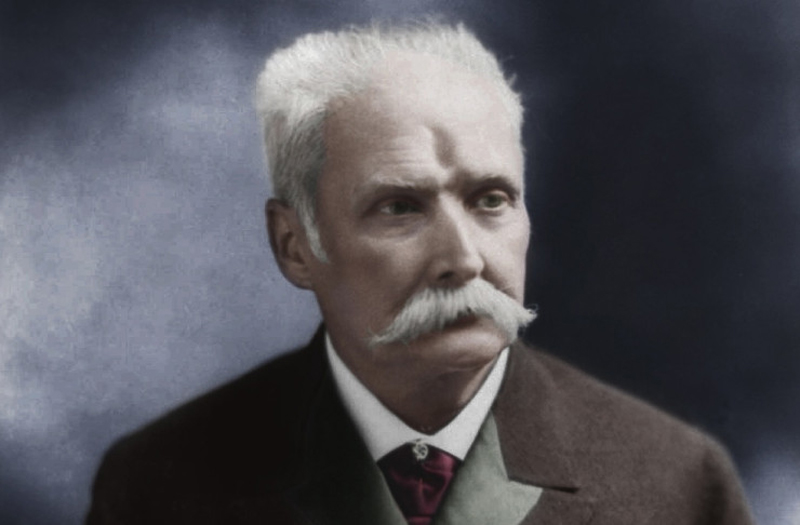
On December 11, 1898, Calixto García Íñiguez, Major General of the Liberation Army and combatant in all three of Cuba's wars of independence, died of fulminant pneumonia while fulfilling his duty in Washington, D.C., where he was advocating for the rights of the members of that force.
The Mambises (Cuban independence fighters) nearly won the Necessary War initiated by José Martí in 1895 and yet they were discharged without justice or recognition by the United States government, which occupied the nation.
General García's countrymen called him the Lion of Holguín in his time, for his bravery and skills in the field of military strategy. The phrase by the Apostle José Martí also remained forever, when he described him as the man with the star on his forehead, alluding to the scar on his forehead from a self-inflicted gunshot and as a distinction for his honorable career.
He came into the world on August 4, 1839, in the city of Holguín, and from an early age he took on work in commerce, while studying on his own with the aim of pursuing a university career.
From his native land, he moved to live in Bayamo, then Havana, and finally in Jiguaní, Oriente.
He could not achieve his dream of higher education, but in Jiguaní he managed and worked in the brickyard belonging to his mother, Lucía Iñiguez, and married very young to Isabel Vélez, with whom he formed a family of six children.
When the first war broke out on October 10, 1868, he joined the campaign from October 13.
He soon began to stand out, first under the command of General Donato Mármol, and later he joined the General Staff of General Máximo Gómez.
He became very effective in combat, contributing his own strategies; thanks to the quickness of his natural intelligence, his creativity stood out.
He even displayed technical knowledge due to his habit of self-improvement through self-study, which never left him.
He was the general who made the most use of artillery; he planned in detail the siege of communities and cities, as well as assaults on enemy columns.
He participated in the Ten Years' War (1868-1878), the Little War (1879-1880), and the Necessary War (1895-1898).
In September 1874, the enemy surrounded him in San Antonio de Baja, near Bayamo. He preferred to die by his own hand rather than be captured by the Spanish and shot himself under the chin. He did not achieve his aim: the bullet exited through his forehead, leaving a scar.
He was taken prisoner and in serious condition was sent to prisons in the metropolis, where he remained for four years. Shortly after the Pact of Zanjón, on February 10, 1878, he regained his freedom.
He traveled to New York with the purpose of preparing for war and there presided over the Cuban Revolutionary Committee that readied the so-called Little War.
Back in Cuba for that campaign, he fell ill and, seeing that conditions were not right for the fight, he capitulated on August 3, 1880, and was deported to Spain.
When the War of '95 began, he decided to return to New York to join the combat from there.
He landed in Cuba on March 24, 1896, leading 78 expeditionaries, through the enclave of Maraví, northeast of Baracoa.
After the fall of Major General Antonio Maceo on December 7, 1896, he was appointed Lieutenant General of the Liberation Army and maintained the position of chief of the Eastern Department.
When the United States intervened to thwart the independence of the Cubans, he led the mambises in the capture of Santiago de Cuba, but later the invading troops denied them entry into the city.
General García's dignity made him resign from his position as chief of the Eastern Department and head with his troops towards Jiguaní.
The Government Council removed him from his position as Lieutenant General of the Liberation Army. Days later, they managed to enter Santiago de Cuba, where he was the subject of a great popular reception.
He was elected delegate to the Assembly of Representatives of Santa Cruz del Sur and, leading a commission, traveled to the U.S. capital to seek recognition of that body, as well as the necessary resources for the discharge of the members of the Liberation Army.
During that mission, he fell ill with pneumonia and passed away on December 11, 1898.
The Cuban cause was frustrated, and justice was not achieved for the combatants. But the flag planted by General García holds a place in the pantheon of the founding fathers of the Cuban nation. (ACN) (Photo: Taken from the Internet)