
Radio Cadena Agramonte emisiora de Camagüey





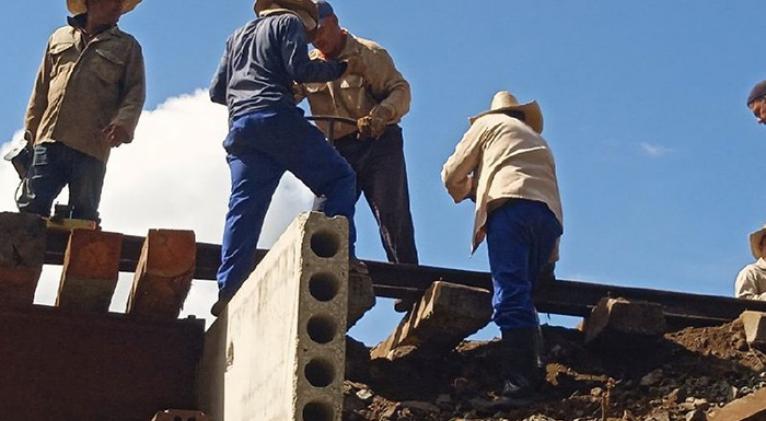
Camagüey, May 6th. - The replacement of the broken ones in sections of the seven bridges with the greatest deterioration, of the 14 existing in Camagüey, among them the one located at kilometer 287, in the Senado area, distinguishes the recovery actions that continue during the current month of May on the railway of northern Cuba.
The state of the road in the aforementioned structures (about 375, according to inventory), is from regular to bad, based on the situation of the woodfty naughty ones that require, which will be provided by the Forest Company of Ciego de Ávila, as it has done for the change of the sleepers in the other half recovered.
In the case of the aforementioned bridge, known as the Máximo River, it requires the intervention of a Hincapilotes crane, which was working on the other section, corresponding to the provinces of Sancti Spíritus and Ciego de Ávila.
Already the pilots are swollen, we only need to sting them at the height of the bridge and placing the heads (support the structure), work these are planned this month along with another team of this type, that of the aid train, which has the demarcation, explained to the Cuban News Agency Modesto Jiménez García, director of the Business Unit of Base Vías and Puentes Cague.
The manager abounded that what was projected on the platform of kilometer 287 will continue what has been done previously, hence it must be carried out in a short time, which, together with the replacement of the naughty ones, will allow to restore the movement of passenger and freight trains along the northern line, projected for July by the Union of Railways of Cuba.
It stands out within the great impact of this reopening, being able to resume the trips of the Nuevitas-Santa Clara train, long awaited more than two and a half years ago by the inhabitants of several municipalities and rural communities of the provinces located in the northern region of the country.
Since the start of the work in order to resume the passage on the north line, he added, the brigades of the entity have worked on the cleaning of the road bed and the chapea in the girdle of the road, as well as the maintenance of the sections that give access to the bridges, the entrance and exit, with the aim of maintaining their levelling and footwear.
The territorial company, also called Solcar, serves 101 kilometers of that railway, which extends from the limits between Camaguey and Ciego de Ávila, in Esmeralda, to the area of Tiffin, where is the link with the branch of the city of Nuevitas.
Likewise, they are responsible for the maintenance of the track, the bridges and sewers on the section of kilometer 464 to 618, on the central line.
The northern railway, one of the largest accesses to the trade of the sugar industry in the early 20th century, was built between 1916 and 1919; it has its center in Morón, and comprises parts of the provinces of Villa Clara, Sancti Spíritus, Ciego de Ávila and Camaguey, linking the ports of Caibarién and Nuevitas.
This connection favored, after the completion of the main line from Morón to Santa Clara, the direct traffic between Nuevitas and Havana. (Text and Photo: Cubasí)