
Radio Cadena Agramonte emisiora de Camagüey





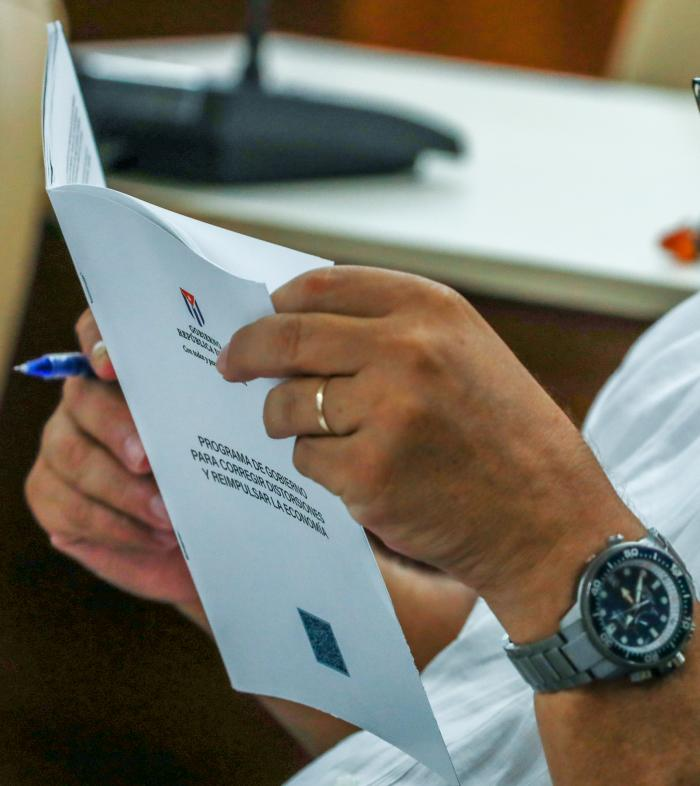
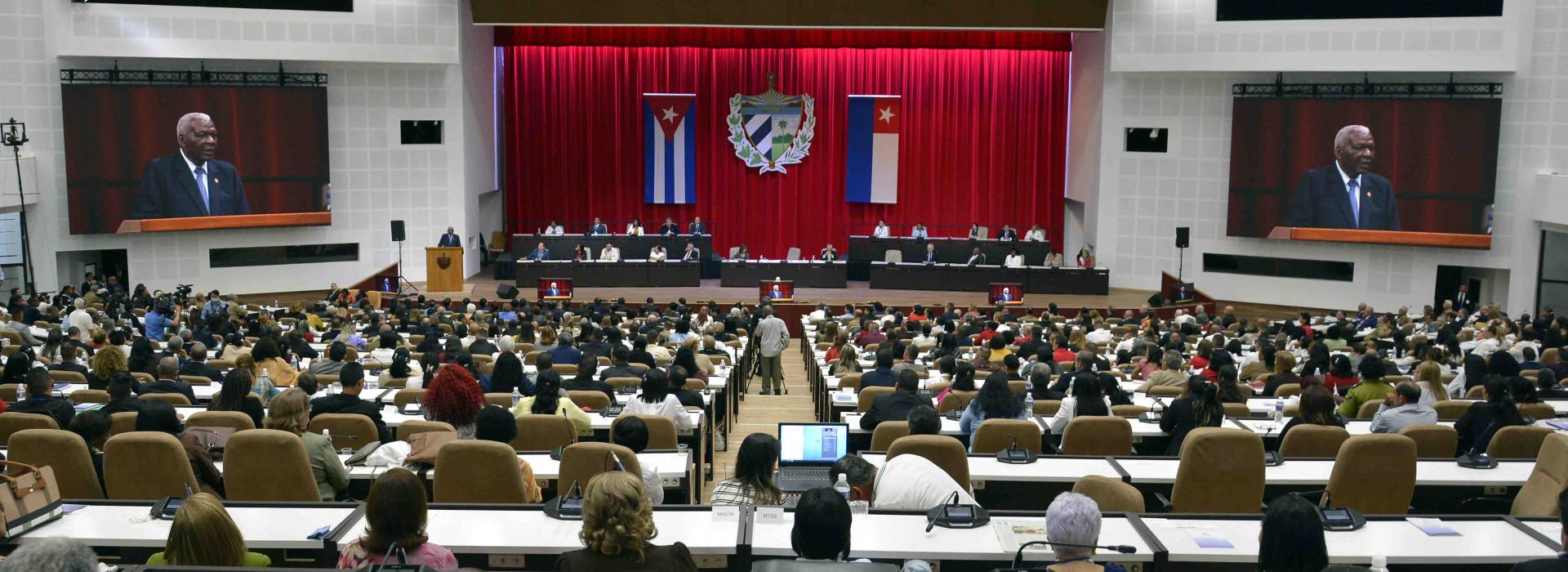
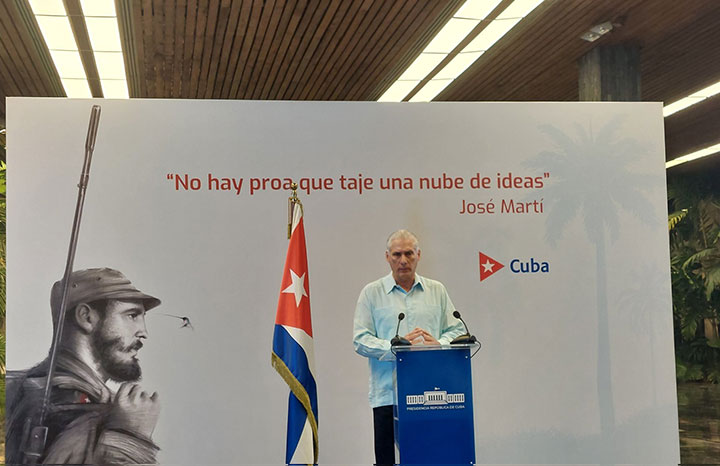
Havana, Dec 6.- With the certainty that the best solutions always arise from participation and collective construction, the Government Economic Group, headed by the member of the Political Bureau and Prime Minister, Manuel Marrero Cruz, exchanged this Friday with deputies to the National Assembly of People's Power (ANPP, for its acronym in Spanish) on the Government Program, in the context of the study and analysis process taking place in the country.
In the meeting, which continued the debates held in the Fifth Ordinary Session Period last July, the proposals made by the deputies were evaluated, referring mainly to the macroeconomic stabilization program, the increase and diversification of external income, the increase in national production, with emphasis on food, as well as the management of the socialist state-owned enterprise and other economic actors and territorial development.
Marrero Cruz explained the work system established for the systematic updating of the Program, a process in which the criteria of the deputies, as well as experts from various sectors, have been taken into account. In addition, he insisted on the coherence and integration with the Guidelines of the Economic and Social Policy of the Party and the Revolution, and the National Economic and Social Development Plan until 2030.
In the exchange, which included the participation of the member of the Political Bureau and secretary of the Council of Ministers, Division General José Amado Ricardo Guerra, the member of the Secretariat and head of the Productive Economic Department of the Central Committee of the Party, Jorge Luis Broche Lorenzo, reported that, as part of the analysis and study of the Government Program, 6,361 meetings have been held, in which 54,372 interventions have been generated and, from them, 12,900 proposals.
The objectives that have generated the most proposals, he added, are those referring to macroeconomic stabilization, social policies, national production, with emphasis on food, and the general directives for the prevention and confrontation of crime.
This popular participation process, far from any formalism, aims –he emphasized– for the population to know the Program and the interrelationship between the general, specific objectives and the actions; that each one, from their sphere of competence, evaluates how they fit in and what corresponds to them to do and, above all, that they contribute.
Regarding the study and analysis of the Program, the Prime Minister reiterated that it is a very valuable exercise, which will allow enriching the document and will help to precisely define its scope to achieve the main transformations demanded by our economy.
In the session, the deputies highlighted the integration of the Program with the guiding documents, agreed on the strength that people's participation provides, and emphasized the need to adapt the debates to the particularities of each place, so that the proposals are objective.
Deputy Emilio Interián Rodríguez called attention to the need to stimulate those producers who want to do, because the few resources we have we must put them where they will multiply, where there is knowledge and the desire to reproduce them.
On the complexities facing the economy with the tightening of the blockade, the fall in GDP, exports, and foreign currency income, spoke Deputy Ian Pedro Carbonell Karell, director of Macroeconomic Policies of the Central Bank of Cuba, who acknowledged that all this has marked a deterioration in our level of life.
The financial measures, he said, do not solve problems on their own; the problems are solved by working, producing, exporting, but they will allow creating the conditions to gradually recover. We must adopt bold, courageous measures, and we must communicate them well so that the people understand them, support them, and so that entrepreneurs know how to take advantage of them.
To those who say that the Revolution is stalled, the Government Program disproves them, reflected Deputy Yusuam Palacios Ortega. "As long as we continue doing these analyses, as long as we are busy transforming the reality of our people, we continue the Revolution, a permanent Revolution."
The need to stimulate the exporting sector and continue incentivizing foreign investment, the strengthening of the ONAT, the implementation of the foreign exchange market, attention to informal employment, and the challenges imposed by demographic dynamics were other topics addressed by the deputies.
Correcting distortions and contributing to re-boosting the country's economy, based on prevention and action against crime, are the main priorities of the Attorney General's Office (FGR, for its acronym in Spanish) within the framework of the Government Program, stated Yamila Peña Ojeda, Attorney General of the Republic, in the debate on the document held at that body's headquarters.
As a State body with the mission of controlling the investigation and criminal action, and ensuring compliance with the Constitution, laws, and legal provisions, one of the main topics to develop in the political process will be the control of money laundering, drug trafficking, and tax evasion.
Reynaldo Cruz Rivera, Deputy Attorney General of the Republic, highlighted that investigations within the National Energy System are among the main guidelines to boost the country's economy, as well as the control of legality in tourism activity and fuel trade.
Another of the highlighted priorities was the protection of people in vulnerable situations. On this topic, Alina Montesino Lee, also Deputy Attorney General, emphasized the need to implement measures in the Health system that link family doctors and nurses, so that, together with social workers, they can identify these cases and provide better care or proceed to report in cases of violence. (Text and photo: Granma Digital)