
Radio Cadena Agramonte emisiora de Camagüey





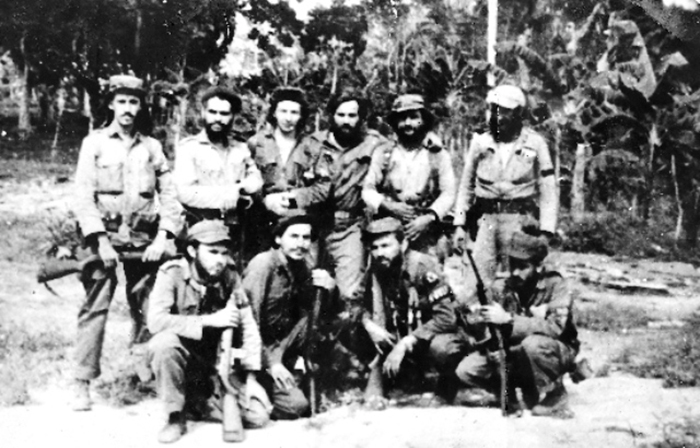
On March 11, 1958, the Second Eastern Front Frank País was created, under the command of then-Commander Raúl Castro Ruz, after overcoming a long and risky journey from the Sierra Maestra to reach Piloto del Medio, in the foothills of the Sierra Cristal.
Previously, through orders issued on February 27, the supreme leader of the Rebel Army, Fidel Castro Ruz, promoted Captains Raúl Castro Ruz and Juan Almeida to the rank of commander and formalized the creation of Columns 6 and 3.
The first, under Raúl's command, would operate in the territory located in the north and east of Oriente province, from the municipality of Mayarí to Baracoa; and the 3rd, in the east of the Sierra Maestra.
Both columns converged on March 1 at Che Guevara's command post in Pata de la Mesa, where Commander-in-Chief Fidel Castro bid them farewell. Together they began the march towards their respective territories.
The mission entrusted to Raúl was complex. The 67 men, distributed into a command squad and four platoons, led by Félix Pena Díaz, CiroFrías Cabrera, Reinero Jiménez Lage, and EfigenioAmeijeiras Delgado, had to cross a vast region of the Cauto Valley to the foothills of Pinares de Mayarí, an area constantly patrolled by Batista's army forces.
Efigenio, then second chief of Column 6 "Frank País," in his book Másallá de nosotros. Columna No. 6 "Juan M. Ameijeiras", recalled that moment: "[…] We left somewhat thoughtful at the idea of the unknown, but everyone with great optimism to fulfill the mission."
"On March 10, after several days of marching, we arrived at the town of San Lorenzo — the place where Carlos Manuel de Céspedes, the Father of the Nation, fell. Taking advantage of the fact that that day was an anniversary of the coup d'état and the enemy was barracks-bound expecting attacks, Raúl decided to cross the plains of Oriente province in vehicles. We made the crossing at night, without incident. At dawn, we arrived near the foothills of the Sierra Cristal."
The rebels, passing through Mangos de Baraguá, paid homage to Major General Antonio Maceo. On March 11, they left the vehicles in Jimbambay and began their first hike through the aforementioned mountain range. At four in the afternoon they arrived at Piloto del Medio, where the Second Eastern Front "Frank País" was officially opened.
The Front was structured from August 1958 into five guerrilla columns: Number 6 Juan Manuel Ameijeiras, Number 19 José Tey, Number 17 Abel Santamaría, Number 18 Antonio LópezFernández, and Number 20 Gustavo Fraga. The sixth, created in October of that year, was Number 16 Enrique Hart. Mobile Shock Units were also created.
Raúl established an exemplary structure in the place for this epic feat. On October 12, through Order 49, the "Organic Law of the Front" was promulgated, "which included the six Columns that were operating, the Rebel Air Force, the departments of the Central Command, the Agrarian and Workers' Bureaus, the directorate for their attention (the Inter-departmental), and the Personnel and Inspection directorate."
He also organized 20 hospitals and medical posts, and about 400 schools, among other benefits for the mountain population.
The bravery of the head of the Second Front would be tested in the heat of combat. One of those moments was on April 13, when they attacked the barracks in the town of Soledad. Division General (Ret.) Samuel RodilesPlanas, who was among the members of that troop, expressed it thus to this journalist for the book Los Rodiles, pasión de siempreviva.
"The combat lasted a long time, almost until dawn. There was strong resistance from the enemy, which prevented us from taking the barracks. We fired a large number of M-26 grenades. Next to me were Luis Felipe Ayra and Félix Lugones, 'Pilón,' both wounded, the latter in a leg," he stated.
Samuel pointed out that they seized some horses without saddles, and Raúl and other comrades transported the wounded on them. That very humane gesture from their commander moved them, but they were also concerned about the intrepidity he demonstrated in combat, during which he fought like any other soldier.
Very important moments were experienced on the Second Front. On September 21, 1958, the Peasant Congress in Arms took place. Grassroots peasant leaders from various parts of Oriente, defying Batista's troops, reached the meeting through their own efforts.
Inaugurating the gathering, Raúl highlighted "the democratic nature of the event, where peasants could express themselves freely, and said that the Rebel Army was their own Army."
Another significant moment was the Workers' Congress in Arms, which met on December 8 and 9 in Soledad de Mayarí Arriba. The attendees "were not limited to the economic aspect, but also addressed political-social issues and left ample room for workers' representatives to raise other aspects of interest."
The heroism of the combatants of the Second Eastern Front Frank País materialized in multiple combats against the Batista army. They, with their chief at the forefront, fulfilled the objectives set by Commander-in-Chief Fidel Castro and, in his words, "was a model of organization and efficiency and played a role of extraordinary strategic importance in our war." (ACN) (Photo: Taken from Internet)