
Radio Cadena Agramonte emisiora de Camagüey





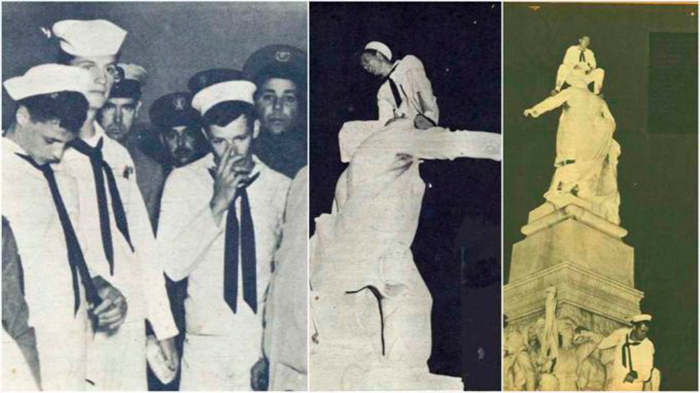
During the night of March 11, 1949, a group of drunken US Marines, from ships anchored in Havana Bay, desecrated the statue of José Martí in the city's Central Park.
That night, the scandals and excesses of the Yankee crewmen seemed to promise just another day to which the people of Havana and residents of other ports appeared to have become accustomed with the arrival of warships, to the delight of brothel keepers, drug traffickers, and any other dirty business designed to satisfy the lowest instincts of those sailors.
At that time, the country was governed by Carlos Prío Socarrás and his political coalition, the Authentic Party, which, by betraying the anti-Machado Revolution of which the president claimed to be a follower, instituted rampant corruption, gangsterism, and a visceral anti-communism, leading to the deaths of labor leaders Jesús Menéndez and Aracelio Iglesias, among others.
Thus was consolidated the destiny of a giant brothel for the beautiful Caribbean city, since in December 1945, the heads of the North American mafia, Lucky Luciano and Meyer Lansky, met at the National Hotel, with the blessing and participation of the Authentic president himself, and decided that part of their businesses associated with drugs, prostitution, and illegal gambling would be based in Cuba.
That was the social context of the night of March 11, when three members of the flotilla headed by the aircraft carrier Palau attempted to climb the statue of José Martí in Central Park, and one of them managed to sit on its head and use it as a urinal, while the other two cheered him with grotesque shouts from the ground.
Only the intervention of the police saved them from a beating, as they repressed the people who spontaneously wanted to take justice into their own hands against the desecrators, who were led under the protection of patrol cars to the Dragones and Zulueta Police Station.
There, hours later, an officer from the US naval forces picked them up.
The unprecedented event was captured for history by a photographer who worked in the area's nightclubs and sold the images to the national press, which reported the incident, mainly denounced by the newspaper Hoy, of the Popular Socialist (Communist) Party, causing a national commotion of rejection of such an affront.
In the early hours of March 12, Central Park hosted a public act of redress for the National Hero, in which speakers from the University Students Federation, the labor movement, and leftist organizations participated, while dozens of wreaths were laid at the base of the monument.
Meanwhile, the regime's Minister of Foreign Affairs tried in vain to calm the situation and went to such extremes of submission that his own family paid for the wreath that the US ambassador sent to the Apostle's monument, which would last only a short time before being destroyed by the population.
After the speakers at the popular event had spoken, someone shouted the slogan "To the US embassy!" and hundreds of protesters set off along Obispo Street towards the Northern headquarters, which at that time was located in the J.Z. Horter building, on Plaza de Armas, where the Rubén Martínez Villena Library now stands.
Plaza de Armas filled with an enraged crowd under the slogan Down with imperialism and rejection of the desecrators of Martí's memory. At first, the US ambassador, Robert Butler, surrounded by bodyguards, tried unsuccessfully to dissuade the protesters.
Police forces cordoned off the area, beat participants, and targeted the leaders and members of the FEU, among whom stood out a young man named Fidel Castro, who stood up to the thugs, along with his fellow student activists, Baudilio Castellano and Alfredo Guevara.
Given the gravity of the situation, the Cuban authorities, who of course would not prosecute the sailors, agreed with the command of the US Navy flotilla that the three offenders would return to their ship and quickly go back to their territory along with the rest of the crews, which further stimulated popular repudiation.
This event, although it concluded without justice being served against the desecrators, managed to integrate the patriotic and anti-imperialist forces of the time and constituted one of the first actions of the Centennial Generation that would make possible the triumph of January 1, 1959.
77 years after this desecration, the US empire, in its current campaign to restore regimes subjugated to its designs in the region, not excluding the direct intervention of its marines, tries unsuccessfully to make people forget this and all its chapters of aggression. (Text and photo: ACN)