
Radio Cadena Agramonte emisiora de Camagüey





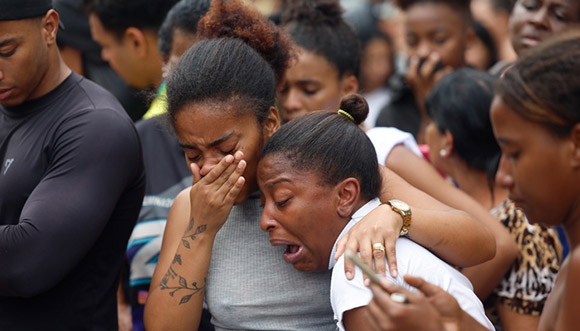
In Rio de Janeiro, the police entered the favela as one enters enemy territory. What followed was not a security operation: it was a massacre. More than 130 people killed, most of them young Black people, executed with the same impunity with which, for centuries, Black blood has been spilled in the name of order.
The scene repeats itself with different accents, languages, and flags: in Colombia's Chocó, where Afro-descendant communities are displaced by the crossfire of paramilitaries and the State; in the east of the Congo, where millions of Black lives have been and are being annihilated under the world's silence; in Sudan, where civil war translates into ethnic cleansing against Black populations rendered invisible by the international press.
Different territories, the same pattern. What unites them is anti-Black racism as a global structure, that system which decides which lives matter and which are disposable. What unites them is the continuity of the anti-Black genocide, a category that does not appear in UN declarations, that doesn't make newspaper headlines, that has no memorials or minutes of silence, but which upholds the world order.
The anti-Black genocide is not an episode nor an excess. It is a long-standing regime. It was born on the slave ships and was consolidated in colonial codes, on plantations, in the creole republics that proclaimed themselves free while keeping racial hierarchies intact.
It is the same regime that, in the name of progress, wiped out entire villages in Africa, and that in Latin America continues to operate every time a police bullet pierces a Black body and the press justifies it by saying they "had a record." Every time the fact that poverty has a color is naturalized. Every time Afro-Argentine identity is denied or Indigenous peoples are reduced to the folkloric category of "minorities," as if the white nation were a self-evident fact and not a violent construct.
The anti-Black genocide is also reproduced in the grammar of power. In hate speech, yes, but also in the omissions of progressives who prefer to speak of "vulnerability" rather than racism. In headlines that list the dead without mentioning their color. In governments that manage inequality as if it were a technical problem and not the consequence of a racial order.
Naming the anti-Black genocide is not a semantic issue; it is a political act. It is to break the pact of silence that turns extermination into statistics and outrage into a trending topic. It is to point out that behind every murdered Black body there is a history of dispossession and a power structure that benefits from that death. It is to understand that racism not only kills, but it organizes the world: who has access to water, to land, to a voice, to mourning.
In Argentina, that same pact of silence operates in another form: denialism. We are told that "there are no Black people here," that "Indigenous peoples are minorities," that "racial mixing saved us from racism." It is the founding myth of a white, European, civilized nation, which erased from its narrative the African and Indigenous genealogies that inhabit it.
That erasure was not a mistake nor an omission: it was a state policy. The anti-Black genocide is also expressed in the impossibility of naming Blackness as a constitutive part of Argentina.
Today, when the global far-right rewrites the language of hate and democracies become complicit by omission, the urgent task is to reclaim the right word. To say anti-Black genocide is not to exaggerate: it is to tell the truth. Because what happens in Rio, in Chocó, in the Congo, or in Sudan are not isolated tragedies; they are chapters of the same history of extermination. And because silence, indifference, and lukewarmness also kill. (Text: Federico Pita/ Cubadebate) (Foto: Cubadebate)