
Radio Cadena Agramonte emisiora de Camagüey





Moscow, Jan. 30 – The hostile U.S. policy towards Iran is driven by a combination of multiple factors, stated Russian Foreign Minister Sergey Lavrov on Thursday in an interview where he was asked whether the motives were the nuclear program, the regional balance of power, or a broader strategy to contain China and Russia.
"All of these are linked. Geopolitically, even under Joe Biden, the United States began to speak not only of an 'axis of evil,' but of an axis of states that truly pose a threat to Western dominance. This included Russia, China, Iran, the Democratic People's Republic of Korea, and sometimes even Belarus as our ally. That'sit. Theydon'thideit," Lavrovsaid.
He added that economic and energy factors also play a role in this hostile policy. He recalled that former U.S. President Donald Trump, when launching the illegal operation against Venezuela and attempting to seize President NicolásMaduro, explicitly stated that Americans needed Venezuelan oil.
"Iranian oil comes from a country that is among the top producers of this commodity. I am practically certain that the Americans would also prefer to control those oil flows. Moreover, unlike Venezuela, which is located in open seas, Iran has the Strait of Hormuz, which gives it its own geostrategic subtleties regarding the security of oil routes. This is also a factor, given the officially and openly stated interests of the Trump Administration," Lavrov elaborated.
Furthermore, the Foreign Minister noted that Israeli Prime Minister Benjamin Netanyahu has never hidden that Iran represents an existential threat to Israel. Lavrov reiterated that Russia wishes to act as a mediator in the region.
"We maintain good relations with both Israel and Iran, and we always offer our good offices to help calm this situation. A little over ten years ago, in 2015, Russia played a key role in reaching an agreement on the Iranian nuclear program, including exporting the excess enriched uranium beyond the agreed amount for the Islamic Republic to our country. We are now ready to do something similar. The Israelis, Iranians, and Americans know this," he said.
"We would be happy to help prevent another escalation of the situation, like what happened during the 12-day war last summer when nuclear facilities under International Atomic Energy Agency (IAEA) control were bombed," he added.
However, he questioned the fact that the IAEA has not spoken out about this flagrant violation of its Statute and the Treaty on the Non-Proliferation of Nuclear Weapons (NPT). "Fortunately, a catastrophe was averted, as the stockpiles of legitimate nuclear material, not prohibited by the NPT, pose a potential threat if attacked with special munitions that penetrate deep into the ground and can breach concrete dozens of meters thick," the minister stated.
"I hope that common sense will prevail, although right now there is much talk about the inevitability of another attack on Iran. I have heard that Turkish President RecepTayyipErdo?an also called for avoiding the worst and that Turkey, like Russia, is willing to mediate. Wehave similar viewsonthis," he summarized.
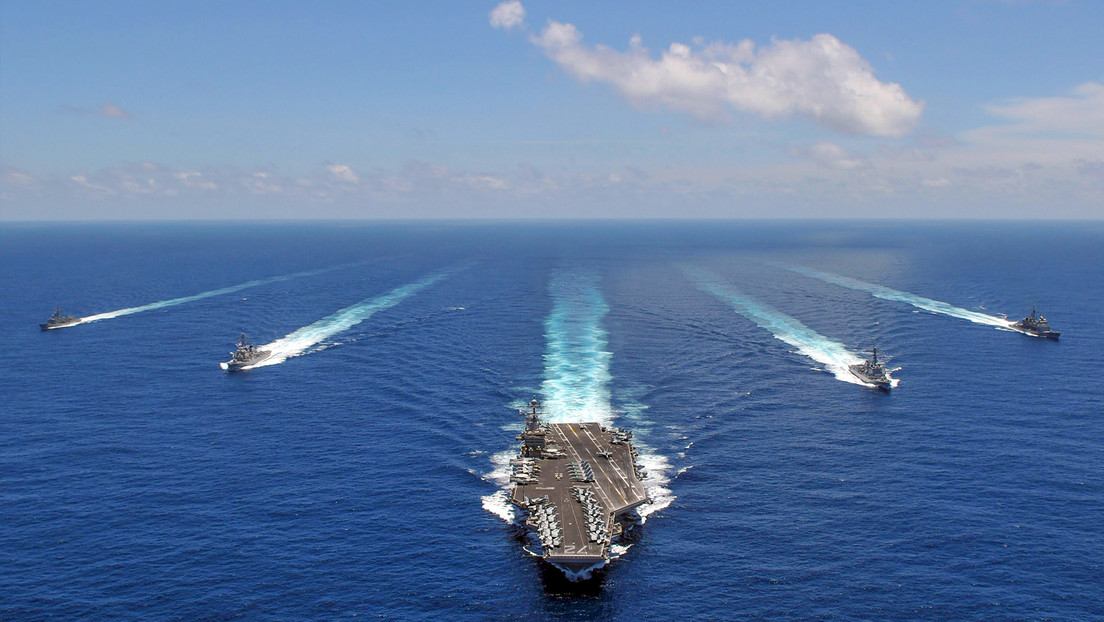
On Wednesday, Trump stated that, as with Venezuela, the U.S. Navy is ready, willing, and able to carry out its mission quickly and violently if necessary. However, he expressed confidence that Tehran would quickly sit down to negotiate a fair, equitable, and nuclear weapons-free deal.
Iran has warned that any military action against it would be considered the start of a war, while stating that its Armed Forces "are prepared, with their finger on the trigger, to respond immediately and forcefully to any aggression." At the same time, it expressed its willingness to maintain a "dialogue based on respect and mutual interests." (Text and photo: RT)