
Radio Cadena Agramonte emisiora de Camagüey





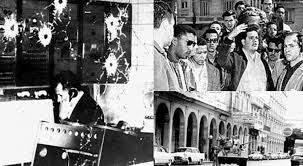
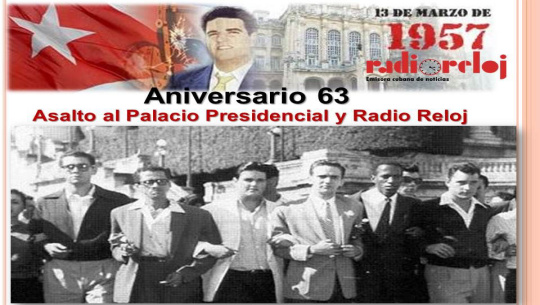
Time further magnifies the value of the sacrifice made at the altar of the homeland on March 13, 1957, by the revolutionary commando unit led by José Antonio Echeverría. Their objective was to execute the tyrant Fulgencio Batista in the very Presidential Palace, and then, to arm the people to initiate a massive struggle that would put an end to the dictatorship.
Echeverría, a prominent university student leader studying Architecture, was the president of the Federation of University Students (FEU, by its acronym in Spanish), founded by Mella in 1922.
Furthermore, he had created the Revolutionary Directorate as the armed wing of the organization representing the progressive and combative student body of the higher education institution.
The daring action coordinated by "Manzanita," the affectionate nickname his friends gave him due to his facial complexion, included the takeover of the national radio station Radio Reloj, located in El Vedado, some distance from the main stage which was the assassin's lair.
According to the plan for March 13, if everything went as intended, they also aimed to take other points in the city, such as the Maestre Police Station, to seize its large arsenal and subsequently occupy other police stations and barracks until dominating the capital.
A year before conceiving this plan, José Antonio had traveled to the Aztec nation [Mexico], where, alongside Fidel Castro, leader of the July 26 Revolutionary Movement —then forced to live in exile— they signed a commitment document for collaboration between the two organizations, inscribed in Cuba's history for their patriotism.
This was the so-called Letter of Mexico, as upright and honest as its creators.
March 13, 1957, ended up being a day of immense pain due to the cold-blooded murder of the young leader and the failure of the action from a military standpoint; consequently, other participants were also killed.
But like all the bitter setbacks faced by genuine fighters, it was also an event that influenced the nation's moral growth, as it made clear what its youngest and bravest children were determined to do to conquer freedom. A process of popular adherence to the cause was underway.
One of José Antonio's final phrases will always resonate, as they did then: "If we fall, may our blood point the way to freedom."
Every March, the remembrance of that heroic feat reaffirms that it was not a useless offering. It made people understand that Cuba was awakening, confronted by bloody repression, and this time the revolutionary movement would not stop, uniting students and the population.
The attack organized for March 13 began in the early morning with the mustering of a small armed detachment of about 50 men, who headed around three in the afternoon towards the Presidential Palace to storm it.
Not everything could happen according to plan, as coincidences or circumstances converged that became strong barriers for the revolutionaries.
The youth commando that penetrated the place with relative ease, due to the surprise factor, and reached the Hall of Mirrors, became confused upon seeing that the tyrant was not in his office, as was usual at that hour.
Another negative factor was that the planned support never arrived: a truck of weapons intended to be used as backup for the combat. Additionally, the presidential garrison confronted the attackers. Carlos Gutiérrez, one of the young revolutionaries, fell mortally wounded.
At the moment José Machado (Machadito) realized the difficulty of the situation, with no possibility of success, he called for a retreat. But he had to return inside the Palace to rescue his comrade Juan Pedro CarbóServiá, upon realizing that he had gotten lost inside the building.
Unaware of the fateful turn of events, José Antonio and another Directorate leader, Fructuoso Rodríguez, headed towards Radio Reloj.
The transmission of his vibrant speech was interrupted and its essential content could not be heard by the population, but it was recorded for history. Today it is a chilling testimony of that boundless patriotism carried out by young Cubans.
Already outside the station, amidst a maelstrom, José Antonio heads towards the University, where other students were supposed to be. Unexpectedly, the car he was traveling in collided with a patrol car that pulled out to cut him off.
As expected, the young man, without backing down, faced the gunmen with his pistol, but they shot him with greater skill and brought him down. There they cowardly finished him off. A street adjacent to his beloved University of Havana received his brutally felled body.
Cubans honor, on every anniversary and always, the beloved José Antonio and all the martyrs sacrificed in the prime of their youth related to the events of March 13, 1957.
In such examples of heroism, the new generations are inspired today, called upon in these times, also of harsh realities, as the Trump administration reinforces its archaic blockade and seeks to bring the children of this homeland to their knees. (ACN) (Photo: Takenfrom Internet)