By Enrique Atiénzar Rivero / Collaborator of Radio Cadena Agramonte.
I look through the mirror of my childhood. I see the image of poverty that surrounded me. I came to the world on a patriotic date, associated with José Martí, on February 24, but in 1946, in the Las Mercedes neighborhood, a neighborhood of humble men and women from Camagüey.
The house I lived in, along with my parents and a sister, was very modest, made of wood, with some separate boards that in the light showed the surroundings: the Junquera winery, the home of the large family of the barber Compa, and the nave of the buses that covered the trip Camagüey-Santa Cruz del Sur.
I seem to see the arrival at the house of my grandmother Silva, Jorge, my uncle, and other relatives, who lived on the grounds of the old El Fénix ice factory. The owners ordered everyone who lived there to leave the place, in exchange for a "little money", and to take with them the materials that made up the property.
I always thought about it: it was an eviction, in the middle of the city of Camagüey in the 1950s.
One morning at the top of a pole, not far away, a red-black flag of July 26 appeared floating with the wind. The author of that revolutionary daring came to be known publicly after the triumph of the Revolution: Rafael López Sarduy, brother of Osvaldo, Ylson and Jorge, young people who were very dear to the neighborhood.
On another occasion, in the early morning darkness, the noise of a vehicle was heard. Through one of the cracks, I saw a jeep with dictatorship guards, wearing the typical yellow uniform, giving their rifle butts to two men who were walking down Calle A. at that time.
Impossible to forget the teachers of primary school # 41 Tula Aguilera: Iluminada de Zayas, Josefina or Minerva, and others who contributed to forming good men and women, such as those of # 6, José de La Luz and Caballero, from San Esteban street: Ángela Pérez and the demanding and upright director Milián.
II
From my house I enjoyed the sunrise on January 1, 1959. I also saw Oscarito come out of where he lived, not far from there, dressed in an olive green uniform and with a 26 bracelet.
A new era began. Not the one my mother grew up in, who at the age of nine was forced to climb on top of a box of soda to scrub at the Perales family home in La Vigía.
Not even my father, turned into a shoeshine, newspaper seller, butcher's messenger, how much appeared … even over the years occupying an assistant position in the railway workshops of Camagüey, where he established himself as a consistent revolutionary and anti-Catholic conspirator, along with men of the stature of Cándido González Morales, Jesús Suárez Gayol, Raúl García Peláez and Jorge Enrique Mendoza Reboredo.
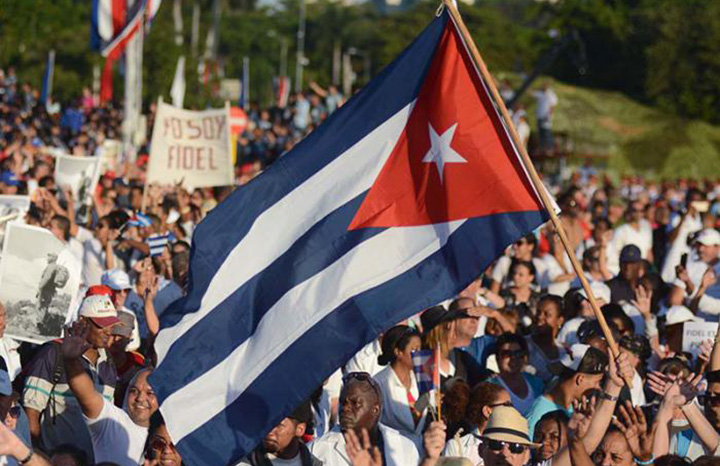
I drank from that sage and rode the Revolutionary Wagon, first admiring Fidel, whom I saw up close on January 4, 1959, on Finlay Avenue, in the Freedom Caravan.
I became a militiaman, I covered guards in strategic places, I learned to define who loved the Revolution and who did not. But I fulfilled my dreams of becoming a revolutionary September 28, 1960, when Fidel called for the creation of the Committee for the Defense of the Revolution (CDR).
In a few weeks, Las Mercedes neighborhood mobilized to bring together all the revolutionaries. I remember one of the active organizers of that task, Oliverio Martín.
How can I forget that night when I was walking the surrounding block with the Professional School of Commerce! He made me accompany an older person who was three times my age. "Take the plate from that car, right now the bomb is bursting," demanded that man with tremendous firmness.
His guess was logical. It was a time when the internal counterrevolution believed that with sabotage or the laying of bombs they were going to overthrow the Revolution.
Inside the high school, where he was studying for high school, now the Vicentina de La Torre Academy of Arts, an explosion was heard. He had time to lean out and see the grass on the lawn dispersed in the air, located very close to the old Lavernia printing house, on the corner of Capdevila.
Among the natural leaders of the youth, Félix Valdés Machado climbed on the hood of a car and condemned the subversive action in the presence of the revolutionary students.
III
There were turbulent times and revolutionary effervescence. On that same campus, faced with the threat of students from Los Maristas private school of having a clash with those who supported the Revolution, one of the spacious premises was filled – less with firearms – with everything that could help defend themselves. The alert did not pass from there.
Under these circumstances the CDRs were born. With the little experience I had, I approached the founding group, Israel Ruiz, Efraín Avilés, Manuel Guzmán and Benjamín Esquivel, based in the Ignacio Agramonte museum. They established the leadership of the mass organization that would spread throughout the once great province.
I accomplished many tasks. I stopped studying by day to do it at night. In that blank we went to 266 Avellaneda Street, where the provincial direction of the CDRs was definitively established. I was her representative before the Provincial Supply Board.
The man with the idea of ??disseminating what the CDRs did was Luis Eduardo Naranjo, a man from Santa Cruz from the Cándido González community, converted by vocation into a front-line propagandist.
Links with the mass media began that way. Radio Cadena Agramonte opened the doors for us and a seasoned group of journalists, led by Rolando Enrique Ramírez Hernández, held out their hands, a gesture of gratitude for life.
That practice endorsed me to substitute in news spaces, accompany the station in special transmissions outside the studios, create an informative space of the CDR in CMJK, later transformed into musical news. Finally, after completing the stage of his military service, he made the jump in 1966 to Adelante newspaper as a member of his team of reporters.
The CDRs consolidated my revolutionary training; I was given the opportunity to be, for several terms, a delegate of the 55th constituency of the People's Power, ascend to a seat in Parliament in the V Legislature, and graduate as a journalist at the Universidad de Oriente through courses directed for workers, while continuing to fulfill other tasks in the union organization.
First, the performance was as an organizer and then, as president of the Union of Journalists of Cuba (UPEC) in the former province of Camagüey, in addition to assuming international collaboration agreements in Bulgaria and the former Soviet Union as an associate member of the International Organization of Journalists (OIP).
The title that colleague José Gilberto Valdés placed in the interview on the occasion of the delivery of the Rolando Enrique Ramírez Hernández Work of Life Award, awarded by the UPEC in Camagüey, was very accurate: Atiénzar, from CDR to journalism. (Photos: Courtesy of José Gilberto Valdés and Rosa Úrsula González)